 Ripple
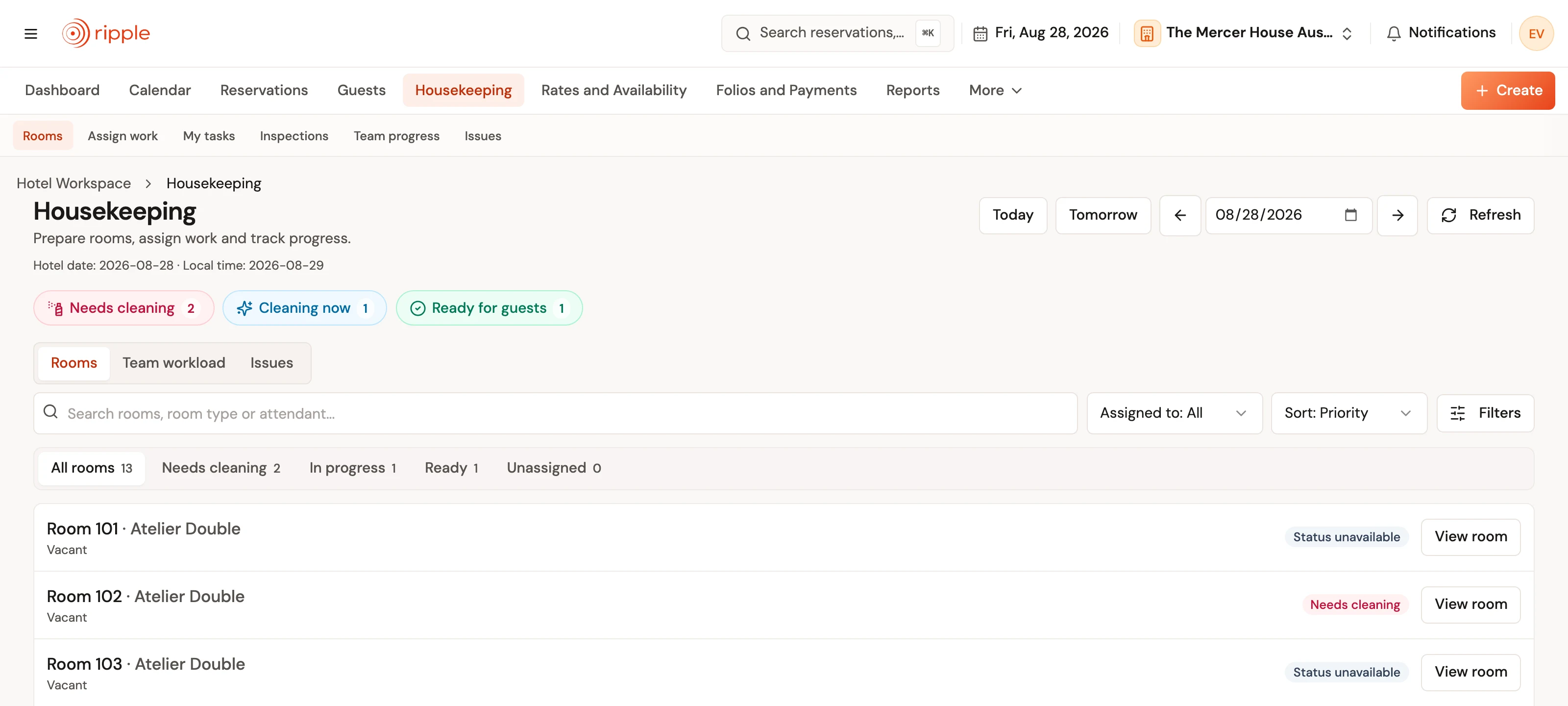
An early arrival is only a problem because nobody can say whether 214 is ready.
When housekeeping status lives on a printed sheet, the front desk is permanently working from information that was true at nine in the morning. That is what turns a routine early arrival into a queue, and a routine late checkout into a room cleaned twice. Making the state shared and current is a smaller change than it sounds, and it removes a category of daily friction rather than a task.
The turnover loop.
The same room, through a day. Every transition is written once and read by everyone.
The guest departs
Check-out drops the room to a dirty state automatically, so nobody has to remember to mark it.
Housekeeping picks it up
The room appears on the day’s list with the stay context that matters — a departure to strip, a stayover to service, a room turning over for an arrival the same day.
The room is serviced
Status is updated as the work is done, from the floor, rather than reported back at the end of a shift.
The desk sees it is ready
The moment a room becomes clean it is available to assign. An early arrival can be seated in the first room that is genuinely ready rather than the first room somebody believes is ready.
Sequence the day before it starts.
Because the board shows which rooms turn over on the same morning, a head housekeeper can plan the order of the floor against the arrivals that are actually coming, rather than working alphabetically and hoping.
- Departures, stayovers and same-day turnovers distinguished
- Room state visible to the desk as it changes
- The day’s load readable against the arrivals it has to serve