 Ripple
A list of arrivals tells you who is coming. It does not tell you that Thursday is impossible.
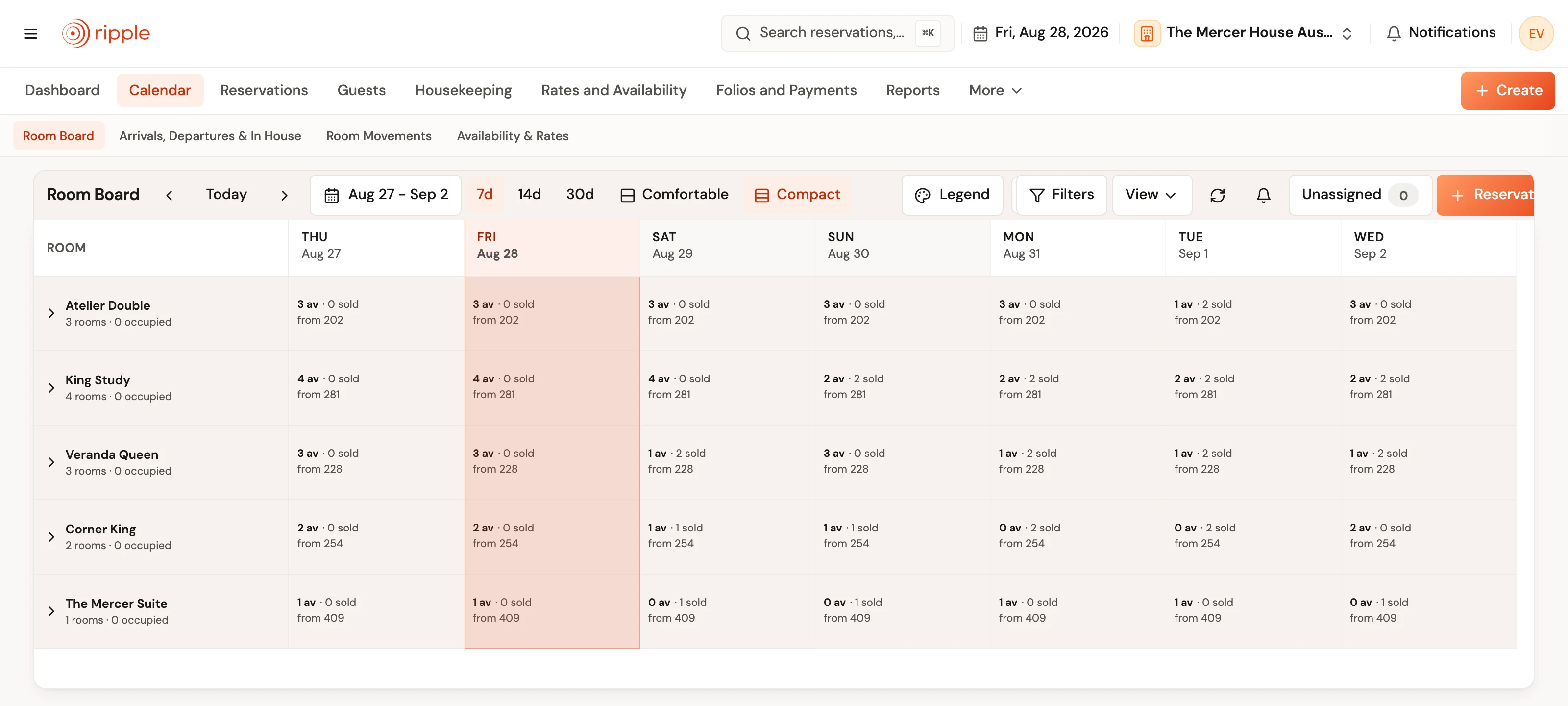
The problems that cost a hotel money are spatial: the one-night gap between two stays that nothing will fill, the accessible room being held by a guest who does not need it, the four rooms that all turn over at eleven. None of those is visible in a percentage or a list. They are obvious on a board, which is why the board is the surface Ripple treats as primary rather than as a nice extra view.
Move a stay by moving it.
Drag a booking to another room or another date and the assignment changes. The board is not a read-only picture of decisions taken elsewhere — it is where the decision is made.
- Drag to reassign a stay between rooms
- Unassigned arrivals held in view until they have a room
- Room state and housekeeping progress visible alongside the stays
When a move will not work, it says so.
Ripple checks the live operational state before committing a room move. If the move conflicts with the stay, the room state or the assignment rules, it returns a clear conflict instead of presenting the action as successful. That is the behaviour that matters at a busy desk: the failure is visible at the moment it happens, to the person who made the move, rather than surfacing at midnight as a double-booked room.
What the board changes.
Three things operators notice in the first week.
- Gaps get filled
- An orphaned night between two stays is visible as a hole in a row. On a list it is invisible, which is why it usually stays empty.
- The turnover is planned, not discovered
- Seeing which rooms turn over on the same morning is what lets a head housekeeper sequence the day before it starts.
- Moves stop being risky
- Because a conflicting move is refused with a reason rather than half-applied, staff stop treating reassignment as something to avoid.